
Letcher Probation and Parole Compared
Both statuses allow a person to live outside a jail or prison while following enforceable conditions. Their source is different. Probation ordinarily comes from a Letcher County sentencing court instead of continued incarceration. Parole follows confinement on a state sentence and depends on action by the Kentucky Parole Board and implementation by the Kentucky Department of Corrections. Mandatory reentry supervision is another Kentucky release status. It moves a covered prisoner into community supervision before projected sentence completion under KRS 439.3406.
The live status matters more than the everyday label. A person may have left a building but remain supervised by KDOC. The Letcher County Jail current-inmate list cannot establish probation, parole, or discharge. Use the Kentucky Offender Online Lookup, known as KOOL, for the state track and the court judgment for probation imposed in a local case.
| Status | Who authorizes it | Best verification |
|---|---|---|
| Probation | Sentencing court | Court order, KOOL, supervising office |
| Parole | Kentucky Parole Board | KOOL history, final Board action, supervising office |
| Mandatory reentry | Kentucky law and KDOC | KOOL and KDOC record |
| Final discharge | Court or corrections authority | Current official discharge record |
Check Letcher Post-Release Supervision
A name match alone is weak evidence. KOOL accepts stronger identifiers and separates current location from county of supervision. Its record may show a prison, county jail, or supervision office. Read each label exactly. A supervision-office location can mean the person has left secure custody but has not finished the sentence or supervision term.
- Open KOOL and search by DOC or PID number when known; otherwise use the most complete name available.
- Compare identifiers, aliases, conviction county, offense information, and photo availability before choosing a record.
- Read supervision status, current location, county of supervision, and the institution or supervision date.
- Use the KDOC Probation and Parole directory to identify the office tied to the displayed county.
- Confirm any court-imposed probation through the Letcher County court and clerk route.
- For parole, compare KOOL history with the Board schedule and request the written action if the result remains unclear.
Letcher Parole Decision Records
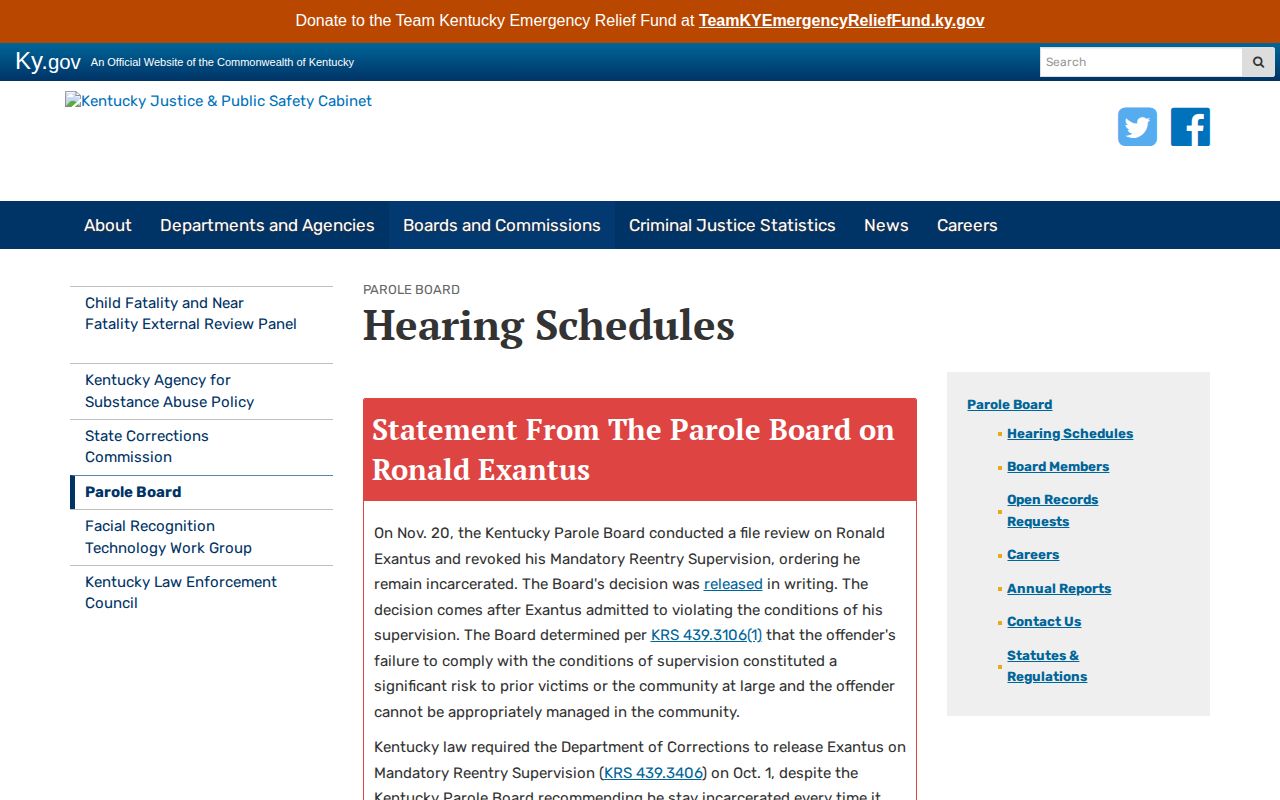
The Kentucky Parole Board decides parole eligibility matters for qualifying state prisoners. Its hearing schedule page publishes monthly schedules and eligibility lists. Hearings are held weekly, start at 8:30 a.m. Eastern, and schedule files are updated on Monday mornings according to the Board. A person may appear on an eligibility list before the actual eligibility month.
A schedule entry is not a grant. Possible actions include grant, denial, deferment, serve-out, rescission, or another procedural result. KOOL can show a person-specific parole-history table with hearing action, deferral, next eligibility, and a proposed release date. For the written order, use the Parole Board open-records route. Physical release and the decision date may differ, so the implemented KOOL status must also be checked.
The official Kentucky Parole Board schedules show the calendar and eligibility routes used for a Letcher County parole check.
Letcher Supervision Office Route
The research did not establish a fixed local office address and hours suitable for publication. The official KDOC directory is the safe routing source because field assignments and district contacts can change. Begin with the displayed KOOL county of supervision, then select the matching district through the Division of Probation and Parole page. The supervising office can verify the public status it is permitted to disclose; the jail cannot verify an active community-supervision assignment.
Kentucky Division of Probation and Parole
Official district directory
Use KOOL county-of-supervision data to select the proper field office.
For a state record request, use KDOC Open Records Requests.
KRS 439.510 restricts parts of probation and parole files. Public records may therefore omit case notes, private reporting details, and other protected material. A narrow request for a final discharge or identified public action is more precise than a demand for the full supervision file.
Letcher Absconder and Violation Status
An absconded notation means the supervising agency alleges that the person stopped meeting location or reporting duties. It does not prove a new conviction. A warrant, violation filing, arrest, or revocation hearing may follow, but each is a distinct event. Check KOOL for the current status, ask the supervising office for allowed confirmation, and use the court docket or Parole Board record for an adjudicated result.
No authoritative public Letcher County absconder list was found. Arrest posts or informal reports should not be turned into one. If KOOL shows an escape or abscond date, record the exact wording and lookup date. A later correction, return to supervision, revocation, or discharge can change the status.
- Absconder
- A person alleged to have stopped meeting supervision and location requirements.
- Violation
- An alleged breach of a supervision condition, subject to the applicable process.
- Revocation
- An official action ending community placement and potentially returning the person to custody.
- Discharge
- The formal end of the sentence or supervision status shown by the responsible authority.
Letcher Release Letters and Identification
Kentucky law provides a practical post-release document route. Under KRS 186.417, eligible felony offenders released through listed mechanisms from KDOC, county, local, regional, or Kentucky federal institutions may receive a release letter with available identity and release information. The statutory process calls for presenting that letter with the other required documents within 30 calendar days.
The release letter can corroborate a person's own release event, but it does not replace KOOL, the court judgment, or a final supervision discharge. Keep the records separate. The letter helps with the identification process; the supervising office confirms active probation or parole, while the responsible court or corrections agency confirms that supervision ended.
Confirm Letcher Supervision Discharge
Supervision ends through an official discharge, sentence expiration, court action, or other authorized disposition. Do not infer discharge from silence in a current jail roster or from an old hearing schedule. Reopen KOOL, check its current status and location, and request the final document from the authority that administered the term. For probation, the Letcher court order is central. For parole or mandatory reentry, KDOC and the Parole Board records define the state path.
KDOC says KOOL entries are updated daily, but accuracy is not guaranteed and data newer than 120 days may not be final. Preserve the lookup date when a precise sequence matters. The Letcher County released-inmate search and record path explains how the jail, court, VINE, and state records fit together when the original custody route is uncertain.
Note: A person can be out of a secure facility and still remain subject to an active Kentucky supervision term.
Letcher Supervision Record Boundaries
Three offices may hold three parts of one post-release story. The Letcher Circuit Court Clerk maintains judgments and later orders. The Parole Board maintains its action. KDOC maintains offender and field-supervision records. A narrow request is more useful than asking each office for the same broad file.
For probation, identify the case and request the judgment, probation order, revocation order, or discharge order. For parole, identify the DOC number and hearing date when seeking the written action. KRS 197.025 and KRS 439.510 may restrict corrections and supervision material.
An old order proves a past status, not a current one. Date each source, then use the current KOOL status, responsible office, and any later discharge record to resolve whether supervision remains active.